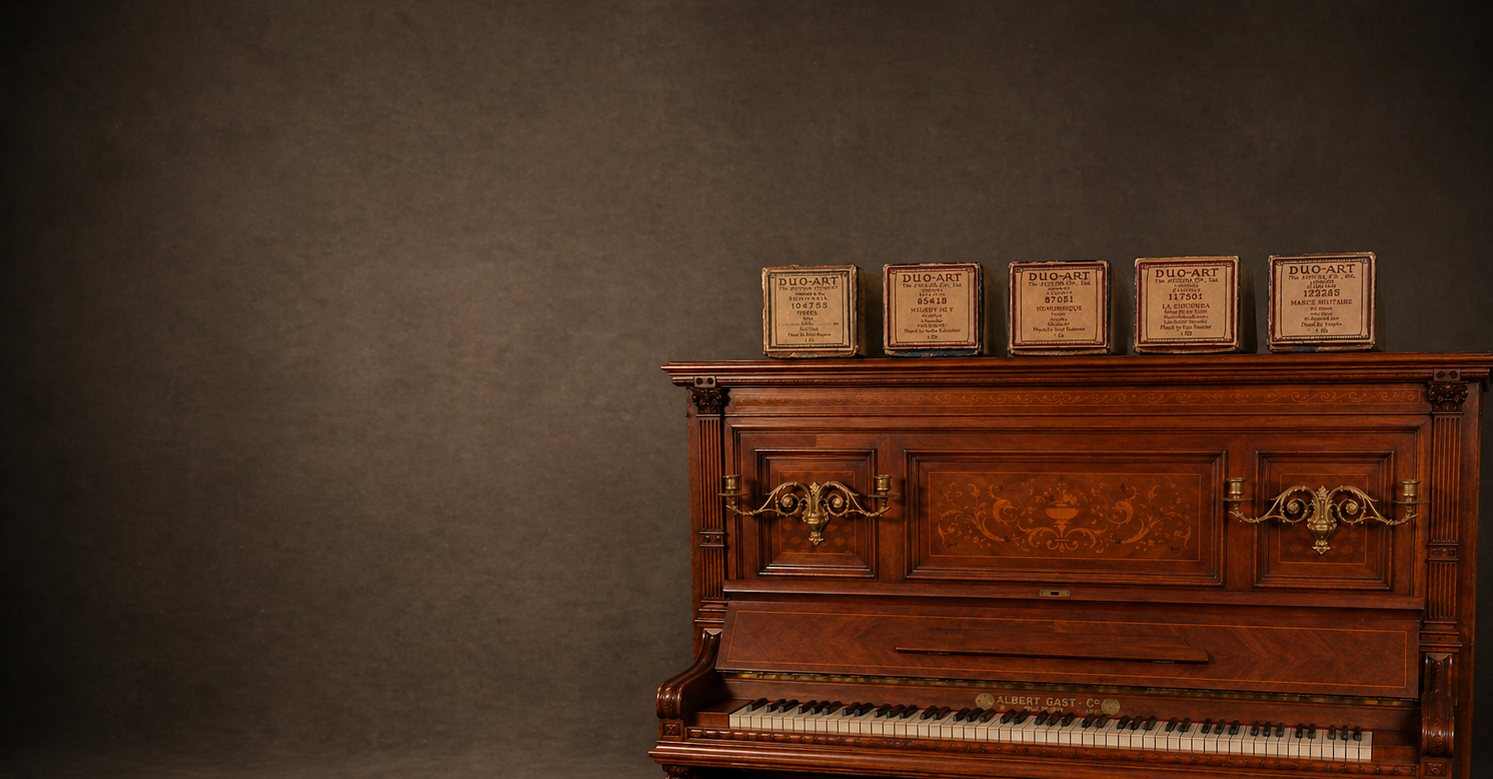
The Aeolian Company was founded in 1887 in New York and quickly became a dominant force in the development of automatic musical instruments. Rather than focusing solely on traditional piano manufacturing, Aeolian initially specialized in mechanical music systems designed to bring live performance into the home.
The Pianola and Early Innovation
Aeolian is best known for developing the Pianola, a player piano system that allowed pianos to be operated automatically using perforated paper rolls. Introduced in the 1890s, the Pianola became a major commercial success and helped popularize player pianos in homes around the world.
Unlike later integrated player pianos, early Pianolas were often external devices that could be attached to standard pianos, greatly expanding their accessibility.
The Duo-Art Reproducing Piano
In the 1920s, Aeolian introduced the Duo-Art system, one of the most advanced reproducing piano technologies of its time. Unlike standard player pianos, Duo-Art instruments were capable of capturing and recreating the nuances of a pianist’s performance, including dynamics and phrasing.
Many famous pianists of the era recorded performances for the Duo-Art system, making these instruments highly desirable and historically significant today.
Expansion and Brand Consolidation
Aeolian’s influence expanded significantly in the early 20th century as it began acquiring established piano manufacturers. This strategy allowed the company to produce instruments under a wide range of brand names while centralizing manufacturing and distribution.
In 1932, Aeolian merged with the American Piano Company to form the Aeolian-American Corporation, further consolidating its position in the industry.
As a result, many piano brands from the mid-20th century were actually produced under the Aeolian umbrella, even though they retained their original names.
Manufacturing and Brand Complexity
Because Aeolian produced pianos under numerous brand names, the quality and construction of these instruments can vary widely. For technicians and buyers, identifying whether a piano was produced by Aeolian—and during which period—is often more important than the brand name on the fallboard.
This makes Aeolian a key reference point when researching lesser-known piano brands.
Decline and Legacy
By the mid-to-late 20th century, demand for player pianos declined, and Aeolian faced increasing competition from international manufacturers. The company gradually lost market share and eventually ceased operations.
Today, Aeolian’s legacy lives on through its innovations in player piano technology and its role in shaping the structure of the American piano industry. Instruments associated with the Duo-Art system and early Pianola designs remain especially significant to collectors and historians.