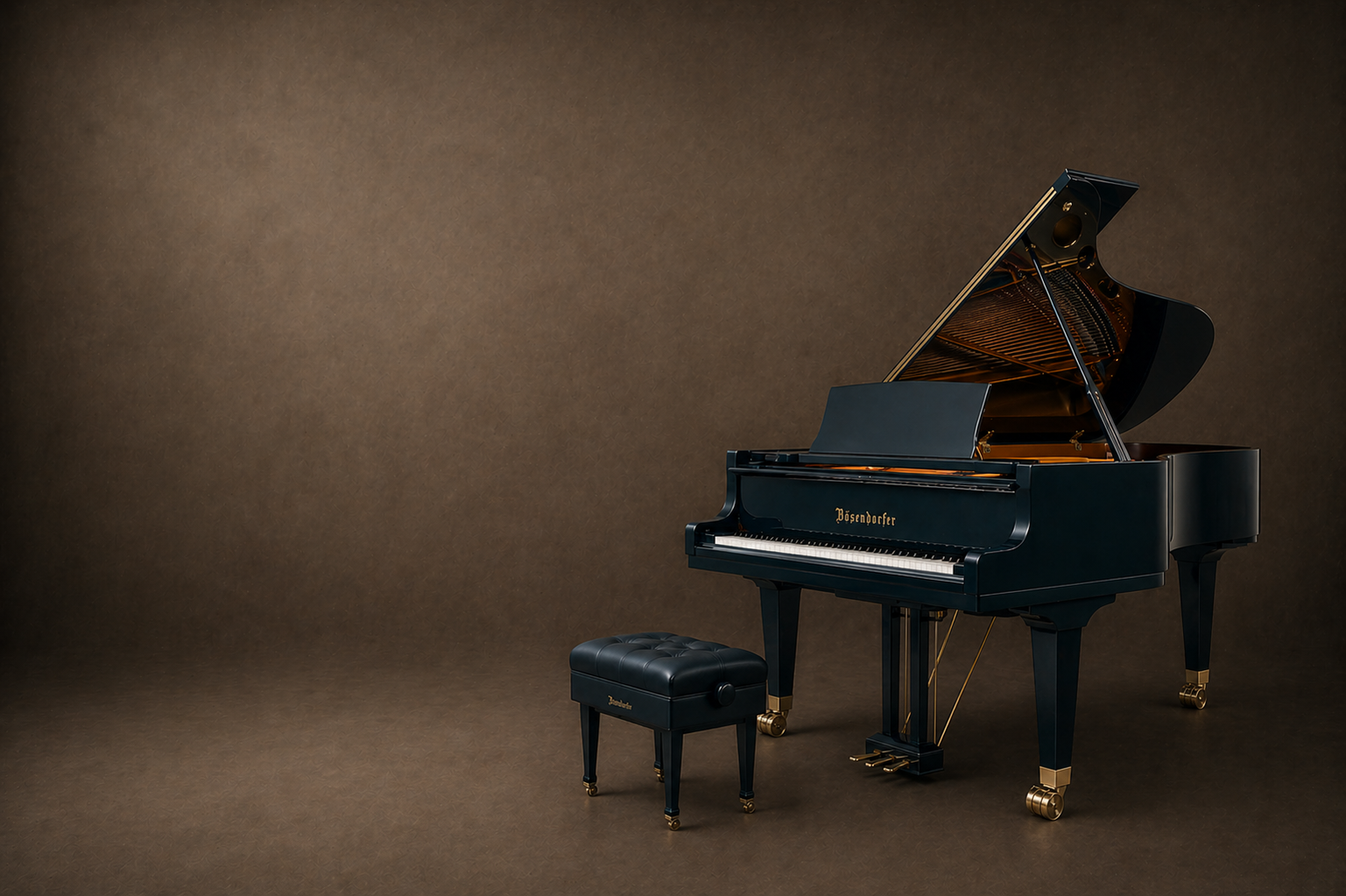
Bösendorfer was founded in 1828 in Vienna, Austria, and is one of the oldest and most prestigious piano manufacturers in the world. The company has long been associated with the Viennese musical tradition and is known for producing instruments with a distinct tonal character.
Viennese Design Philosophy
Bösendorfer pianos are built with a different structural philosophy than many other manufacturers. Instead of relying primarily on the soundboard to project sound, Bösendorfer designs emphasize the entire case as a resonant body.
This results in:
- Greater tonal depth
- Strong low-frequency resonance
- A more “orchestral” sound profile
Imperial Grand and Extended Range
One of Bösendorfer’s most famous innovations is the Imperial 290 concert grand, which features 97 keys instead of the standard 88.
These additional bass notes:
- Extend the instrument’s range
- Add sympathetic resonance even when not directly played
- Contribute to the characteristic depth of the Bösendorfer sound
Tonal Characteristics
Bösendorfer pianos are widely described as having:
- A dark, rich tonal character
- Powerful and resonant bass
- Smooth, blended treble
Compared broadly:
- Less bright and percussive than many Yamaha pianos
- Less “transparent” than Bechstein
- More focused on depth and resonance than clarity alone
Yamaha Ownership
In 2008, Bösendorfer was acquired by Yamaha Corporation.
This is an important distinction:
- Bösendorfer continues to build pianos in Austria
- Traditional construction methods are largely preserved
- Yamaha provides financial stability and global distribution
For technicians and buyers, this means modern Bösendorfer pianos remain high-end instruments, but exist within a larger corporate structure.
Technician and Buyer Perspective
From a technician standpoint:
- Bösendorfer pianos may require different voicing approaches due to their tonal character
- Their construction emphasizes resonance beyond the soundboard
- Regulation and tonal work may differ from more standard designs
For buyers:
- These are premium instruments with a distinct tonal identity
- Selection is often based on personal tonal preference
- The Imperial model offers unique musical possibilities not found in standard pianos
Important Note
Bösendorfer is owned by Yamaha but continues to manufacture pianos in Austria using its traditional design philosophy. The instruments remain distinct from Yamaha pianos despite shared corporate ownership.