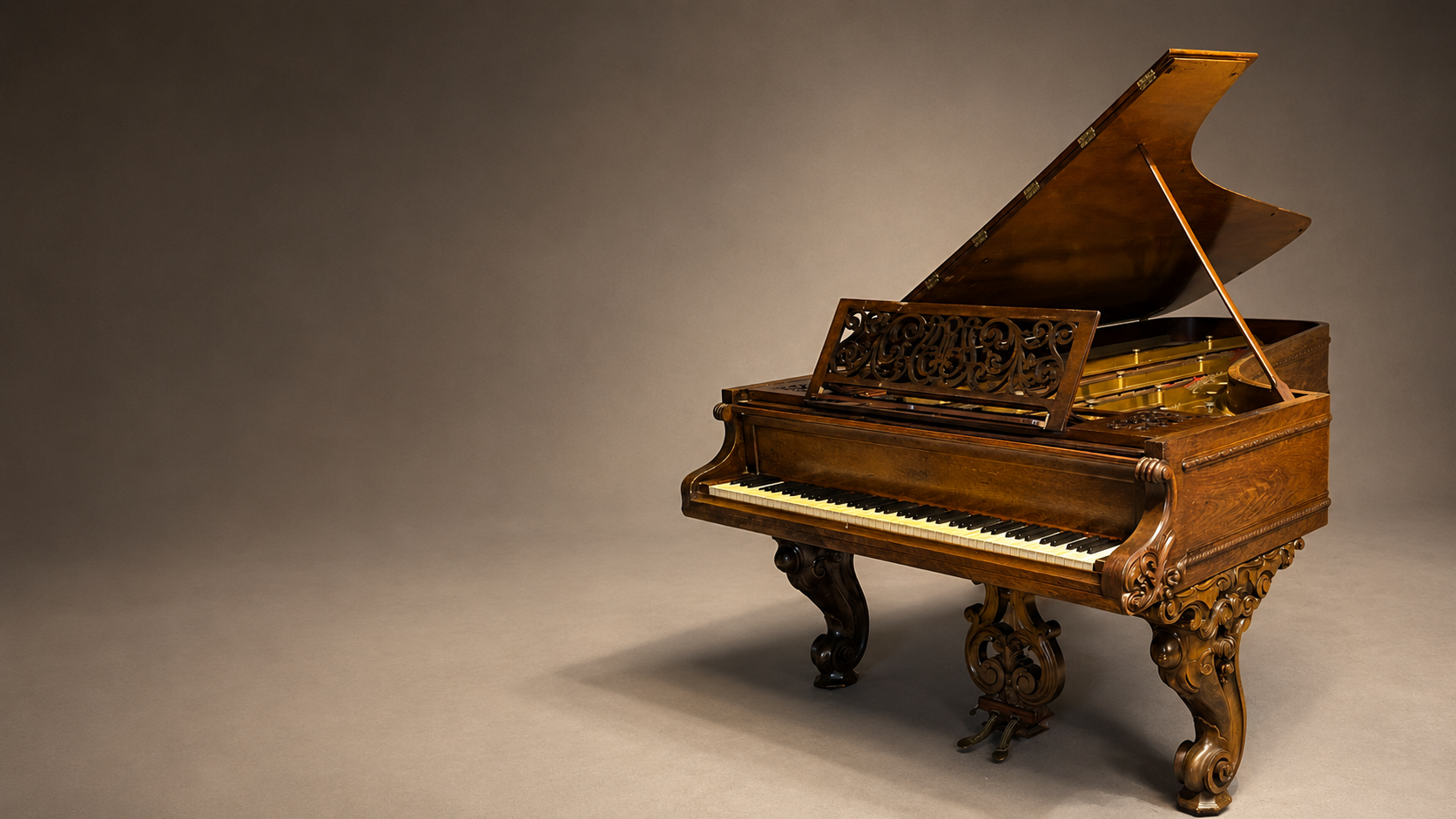
Chickering & Sons was founded in Boston in 1823 by Jonas Chickering and James Stewart. The company became one of the most important early American piano manufacturers and was widely regarded as a leader in the 19th-century piano industry.
Early Boston Years
Jonas Chickering trained as a cabinet maker before entering piano manufacturing. After working in Boston’s early piano-building scene, he formed a partnership with James Stewart in 1823. The original firm was known as Stewart & Chickering, but Stewart left the partnership a few years later.
In 1830, Chickering partnered with John Mackay, whose business and trade connections helped expand the company’s reach. Mackay also supplied access to exotic hardwoods and helped promote Chickering instruments beyond the local Boston market.
Technical Innovation
Chickering’s importance is not just historical; the company made major contributions to piano design.
One of Jonas Chickering’s most important innovations was the development of stronger cast-iron frame designs. In 1840, he patented a one-piece cast-iron frame for square pianos, and in 1843 he applied similar principles to grand piano construction.
These developments were important because stronger frames allowed pianos to handle greater string tension, improving power, stability, and tonal projection.
Chickering was also an early commercial adopter of cross-stringing principles, where bass strings run diagonally across the instrument. This helped place the longer bass strings over a more resonant section of the soundboard and became a core feature of modern piano design.
Golden Age Reputation
During the 19th century, Chickering was one of the most prestigious piano makers in the United States. Before Steinway became dominant, Chickering was widely considered one of the leading American piano manufacturers.
Chickering pianos were used by major performers and appeared in prominent musical settings. The company also built instruments for important cultural and political spaces, including pianos associated with the White House and major concert venues.
The company’s grand pianos from the late 19th and early 20th centuries are especially significant to collectors and restorers. Chickering referred to many of its grand piano designs as “scales,” with scale numbers representing distinct engineering designs.
Chickering Scale Numbers
One useful feature of many Chickering grand pianos is the presence of scale numbers cast directly into the iron plate. These scale numbers can help identify the piano’s model, size, and design lineage.
For technicians and restorers, this is valuable because Chickering’s scale numbers often communicate more precise information than a generic model name.
Corporate Absorption
Chickering’s independent identity began to change in the early 20th century. In 1908, the company became part of the American Piano Company. In 1932, American Piano Company became part of Aeolian-American, one of the largest piano conglomerates in the United States.
This period is important because the Chickering name continued, but production and brand identity were increasingly shaped by larger corporate structures.
The last piano produced by Chickering & Sons itself is commonly reported as having been made in 1983. Aeolian-American ceased trading in 1985, after which the Chickering name passed through Wurlitzer and later Baldwin.
Later Brand Usage
After Aeolian-American’s collapse, the Chickering name continued as a brand asset rather than as the original independent manufacturer. Wurlitzer acquired the name, and Baldwin later acquired both the Wurlitzer and Chickering names. Gibson then acquired Baldwin in the early 2000s.
This later history is essential for buyers and technicians because a Chickering-branded piano from the later period should not automatically be understood as equivalent to a 19th-century or early 20th-century Chickering & Sons instrument.
Technician and Buyer Perspective
For technicians and buyers, Chickering pianos must be evaluated by era.
Broadly:
- Early and Golden Age Chickering instruments can be historically important and musically significant
- Many older Chickering grands and squares may require major restoration due to age
- Later corporate-era Chickering-branded instruments vary depending on who produced them and when
- The name alone is not enough to determine quality, value, or restoration potential
A well-preserved or properly restored Chickering from the company’s prime years can be an important American instrument. However, condition, structural integrity, action work, soundboard condition, and restoration quality matter heavily.
Important Note
Chickering & Sons was one of America’s most important early piano makers, but the original company was eventually absorbed into American Piano Company and later Aeolian-American. After Aeolian-American ceased trading in 1985, the Chickering name passed through Wurlitzer, Baldwin, and Gibson ownership. Later Chickering-branded pianos should not automatically be treated as equivalent to earlier Chickering & Sons instruments.