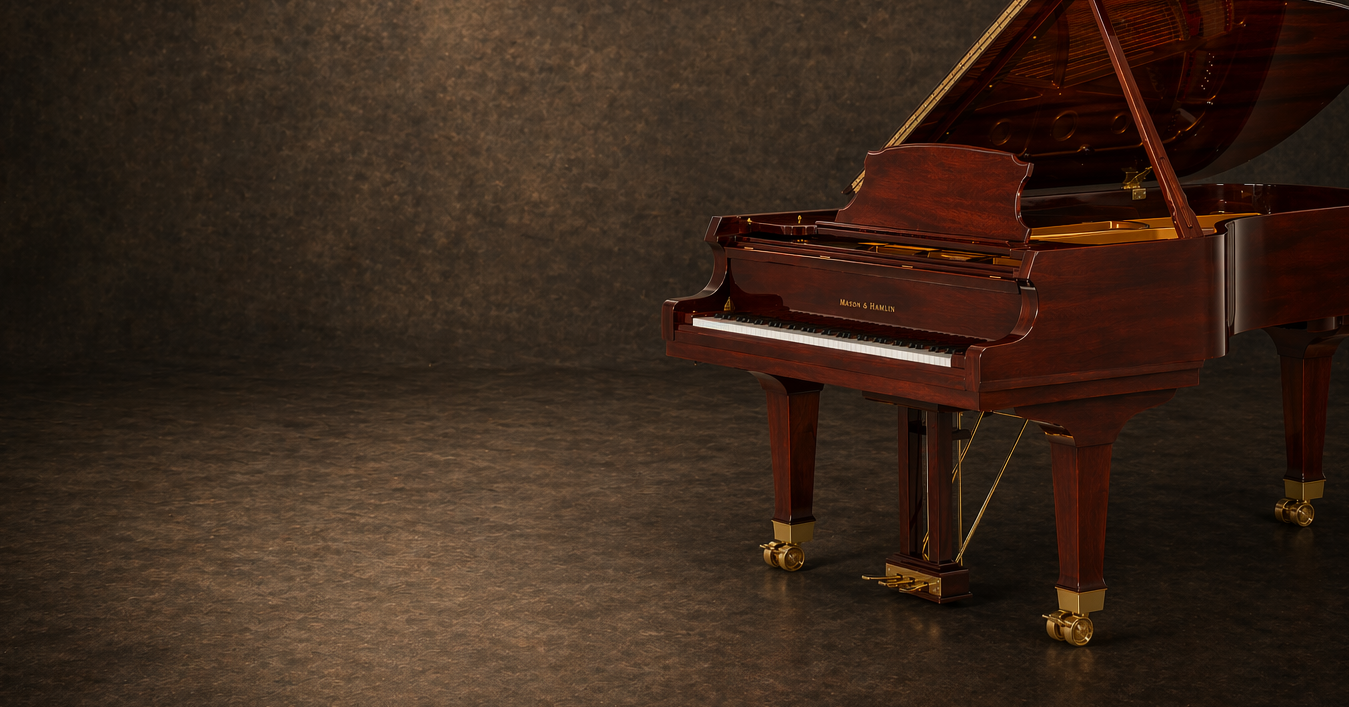
Mason & Hamlin was founded in 1854 in Boston, Massachusetts, and quickly established itself as one of the most innovative American musical instrument manufacturers of its time. Initially known for producing high-quality reed organs, the company later expanded into piano manufacturing, where it would earn a lasting reputation for excellence.
Innovation and Design
Mason & Hamlin is best known for its patented tension resonator system, introduced in the early 20th century. This system uses a series of metal rods within the piano to maintain tension across the soundboard, helping preserve its crown and structural integrity over time.
For technicians, this design is significant because:
- It can help maintain soundboard shape longer than traditional designs
- It contributes to long-term tonal stability
- It makes Mason & Hamlin pianos structurally distinct from most other manufacturers
Tonal Characteristics
Mason & Hamlin pianos are widely recognized for their:
- Dark, rich tonal character
- Strong bass response
- Sustaining power
Compared to Steinway, which is often described as more complex or color-rich, Mason & Hamlin instruments are frequently noted for their power and depth, making them particularly well-suited for large spaces and performance settings.
Aeolian Era
In 1932, Mason & Hamlin became part of the Aeolian-American Corporation. During this period, the brand continued to exist, but production methods and overall consistency changed as part of a larger corporate structure that managed multiple piano brands.
For technicians and buyers, pianos from this era should be evaluated individually, as quality can vary depending on manufacturing period and condition.
Revival and Modern Production
Following the decline of Aeolian-American in the late 20th century, the Mason & Hamlin name was revived, with a renewed focus on high-end piano manufacturing.
Modern Mason & Hamlin pianos are once again produced in the United States and are regarded as premium instruments. The company continues to use the tension resonator system, along with updated materials and construction techniques.
Today, Mason & Hamlin remains one of the few American piano manufacturers producing high-end instruments, often compared directly with Steinway & Sons in terms of performance and build quality.
Technician and Buyer Perspective
For technicians and buyers, Mason & Hamlin pianos are often valued for their structural durability and tonal power. Older instruments, particularly those built before and after the Aeolian era, can be excellent candidates for restoration.
As with many historic brands, understanding the production era is key to accurately assessing quality and long-term performance.