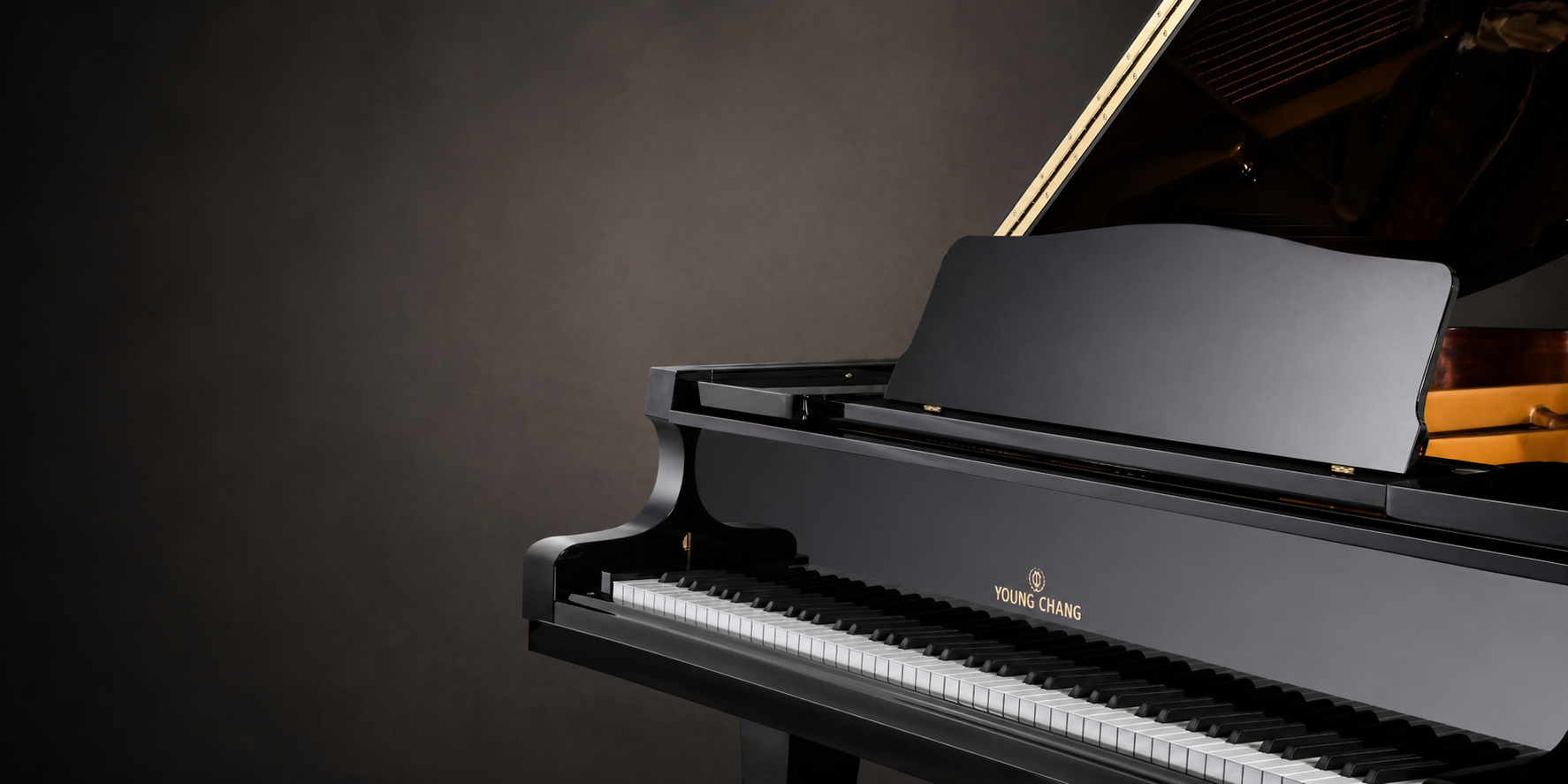
Young Chang was founded in 1956 in South Korea and grew into one of the largest piano manufacturers in the world. The company played a significant role in the global shift toward affordable, mass-produced pianos during the late 20th century.
Manufacturing Scale and Market Role
Young Chang is best understood as both a brand and a manufacturer. Like Samick, it has produced pianos under its own name while also supplying instruments for other brands.
This positions Young Chang as a key contributor to:
- Global piano distribution
- OEM (original equipment manufacturer) production
- Expansion of accessible instruments in Western markets
Quality Evolution and Western Influence
One of the most important developments in Young Chang’s history was its collaboration with Western designers, most notably Joseph Pramberger, a former Steinway engineer.
This influence led to:
- Improvements in scale design
- Better tonal balance
- More refined construction in certain model lines
As a result, later Young Chang pianos are generally considered more consistent and better-designed than earlier production.
Tonal and Performance Characteristics
Young Chang pianos typically offer:
- A clear, straightforward tonal profile
- Reliable performance for home and institutional use
- Improved balance in later models influenced by Western design input
Compared broadly:
- Less refined than high-end European or American instruments
- Comparable to other large-scale Asian manufacturers depending on era and model
Ownership and Industry Consolidation
Following financial challenges during the late 1990s Asian financial crisis, Young Chang underwent restructuring and was eventually acquired by Samick.
This consolidation reflects a broader industry trend:
- Fewer independent manufacturers
- Greater centralization of production
For technicians and buyers, this means:
- Manufacturing origin may overlap with other brands
- Understanding ownership history can provide useful context
Technician and Buyer Perspective
For technicians:
- Young Chang pianos are generally predictable and serviceable
- Quality varies by production era and model line
- Later instruments tend to show improved consistency
For buyers:
- These are typically value-oriented instruments
- Brand name alone is not a reliable indicator of quality
- Condition, model, and production period are key factors
Important Note
Young Chang has produced pianos for multiple brands and is now part of Samick. As a result, both manufacturing origin and ownership history can influence quality and design, making it important to evaluate instruments by era and production context rather than brand name alone.